Sword Summary Warm-up
Don’t have time for the full workout? We’ve got you covered with a quick, high-intensity session. Here are the key takeaways:
- Value-based care is the clearest path out of a fee-for-service system that rewards volume over recovery, but results have been mixed when incentives and accountability are weak.¹ ²
- The next wave is more practical: earlier risk identification, continuous outcomes measurement, and contracts that share real risk and reward.³ ⁴
- Outcome-based pricing in digital MSK is a tangible example of how value-based care can work when payment is tied to measurable improvement and performance is transparent.⁵
Why the healthcare system needs change
Experienced healthcare payers know the pattern of ineffective spend. Costs climb, complexity grows, and “more care” does not reliably translate into better health. Waste is a structural feature of the traditional healthcare system, not a rounding error.¹ The common fee-for-service model keeps rewarding volume and intensity, even when the highest-value choice for a member is earlier, preventative care and clearer navigation.
That is why value-based care is more than just a trend. It is the most credible model for fixing the broken incentives structure in a healthcare system that too often leaks money and trust.
At the same time, skepticism is earned. Large-scale value-based initiatives have not consistently delivered the savings many expected, and independent evaluations show outcomes vary widely by model design, category, and implementation conditions.²³
So what changes now?
5 trends that show how value-based care is maturing
The next wave of the value-based care model is getting more specific and more accountable. It is shifting from broad “value” promises to measurable outcomes, earlier risk identification, and condition-level contracts where incentives are harder to game and easier to audit.
Musculoskeletal (MSK) care is a leading indicator of this shift. It is high-volume, high-variance, and sensitive to fragmented pathways and low-value services.¹ That makes it a proving ground for how value-based care can mature across the rest of healthcare.
| What’s changing | Early value-based care | What’s emerging now | What it means for buyers |
|---|---|---|---|
Risk timing | Identify risk after claims spike | Identify risk before escalation | Fewer surprise spikes, better forecasting |
Outcomes | Annual measures | Continuous, member-level outcomes | Clearer accountability and comparability |
Contracts | Bonuses layered on fee-for-service | Outcome-based pricing to incentivise effective care | Payment aligns with recovery, not volume |
Buyer role | Payers taking on risk with a new approach | More aware, active purchase decisions | Higher proof standards, less patience for fluff |
Tech | Retrospective reporting | AI-supported decision support | Better targeting, governance becomes non-negotiable |
This article gives health plan administrators and benefits plan leaders are high-level pulse check on the changing nature of the healthcare purchasing environment. The following five value-based care trends signal where the market is heading. We also provide explanation on what these trends mean for payers, members, and those vendors who can deliver effective value-based care consistently to provide high-quality member outcomes.
1. Predictive AI is redefining how risk is identified
Traditional models often react after cost escalates. A member’s path has already drifted into repeat imaging, specialist visits, injections, or a surgical consult. By then, even strong utilization management is playing defense.
The emerging pattern is earlier signal detection: using data to identify members who are trending toward a high-cost MSK pathway before the expensive part of the curve. Done well, this is not “AI makes decisions.” It is decision support that helps teams prioritize outreach and speed access to conservative care options.
This shift matters because it changes what you can manage. Instead of only managing average spend, plans can start managing volatility.
How Sword Predict drives a 3.7x ROI on MSK spend
Sword Predict is the industry’s first AI engine built to detect and engage the highest-risk members of a population to proactively reduce the costs of avoidable surgery. Predict’s sophisticated AI-powered detection engine can find and engage high-risk members via personalized outreach before they become high-cost claimants.
The result is exciting for healthcare payers and their members: significant savings, consistently better healthcare outcomes, and a smarter approach to MSK treatment. Predict has been proven to identify people who are 10 to 40 times more likely to get surgery, up to eight months before their procedure⁶.
Validated by matched control studies and third-party research, this white paper reveals how Sword Predict slashes MSK costs and delivers a category-leading 3.7x return on investment⁶.
It’s critical to emphasize that Predict does not override clinician judgment or restrict access to care. The vital value-add for health plans is timing. Earlier identification makes it easier to offer support before the care path becomes harder to change. Rather than reactive and expensive care for more acute problems, Predict provides preventative, less expensive care to avoid those more costly downstream interventions.
2. Continuous outcome measurement is becoming table stakes
Value-based care cannot succeed if outcomes are vague, delayed, or easy to game. One reason earlier efforts disappointed is that buyers were left with proxy metrics: visits, utilization, or process measures that do not always reflect meaningful improvement.
The next wave is more direct: continuous measurement tied to member healthcare outcomes that purchasers can defend (such as improved function, reduced symptoms, and pain interference). Patient-centered outcome measurement has long been emphasized in pain research as a way to compare interventions and define what “better” actually means.⁹
For buyers, this trend has two practical implications:
- You should increasingly expect outcomes at the member level, not just aggregated reporting
- Partners that can measure change reliably at scale are better positioned for effective value-based care
MSK is particularly suited to this shift because improvement is often measurable over weeks, not years. That makes it practical to build contracts that pay for recovery rather than volume. You can expect significant savings within plan-year from the most effective healthcare providers.
3. Risk-based contracting is getting more specific
A major value-based care trend is that risk is becoming less symbolic. The market is moving beyond small quality bonuses layered onto fee-for-service and toward contracts that more explicitly share financial responsibility. This realigns incentives for healthcare providers so that payments are more directly tied to meaningful healthcare outcomes.
This trend is showing up in the form of:
- Condition-specific bundles and episode-based models
- Two-sided risk models where vendors share downside when outcomes are not delivered
- Warranty-like constructs tied to measurable improvement over a defined window
- Outcome-based pricing that reduces the “pay regardless” problem buyers worry about
This evolution is a response to a hard reality: the traditional healthcare system contains well-documented wasted spend and unfortunately, a significant proportion of low-value care¹.
The federal scorecard is a reminder that good intentions are not enough. CBO reported that, in its analysis, CMMI’s activities increased net federal spending by $5.4 billion between 2011 and 2020, underscoring how difficult it is to translate pilots into net savings at scale.² This is where a healthy skepticism is productive, not cynical. It pushes the market toward designs that are easier to audit and validate.
4. Employers are becoming more active purchasers of value
Employers are no longer satisfied being passive payers. Many are well-informed and sophisticated purchasers: demanding comparability, implementation clarity, and proof that vendors can reduce volatility without creating member friction.
The smartest healthcare payers share a few things in common:
- Less patience for models that are hard to explain internally
- Higher demand for claims-based measurement and independent validation
- More scrutiny on adoption, navigation, and member experience
- Increased focus on categories that drive volatility, like musculoskeletal care
This expectation for evaluation discipline is increasingly mirrored in the employer market. Third-party validation is becoming a differentiator. This Risk Strategies Consulting analysis describes an 18-month retrospective cohort design comparing more than 2,700 Sword members to over 5,100 matched controls¹¹. Rigorous, independent ROI analysis like this provides payers with more substantive proof to commit to a purchase decision.
This kind of evidence is easier to take to consultants, finance leaders, and procurement teams because it addresses the question behind most value-based conversations: “How do we know this works in the real world, not just in theory?”
5. Governance and transparency are more important than ever
As AI and risk-based contracting expand, governance becomes a make-or-break issue. Leaders are increasingly accountable for explaining:
- What data is used and how it is protected
- How models are monitored over time
- Whether bias and access issues are being identified and addressed
- How members experience the program, not just what it costs
The JAMA Summit report stresses the need for stronger evaluation infrastructure, oversight, and ongoing monitoring so AI tools are developed, evaluated, regulated, disseminated, and monitored responsibly.⁴
WHO’s guidance reinforces similar principles, including transparency, accountability, inclusion, and equity safeguards.⁷ FDA’s PCCP guidance further signals that “set it and forget it” is not a credible posture for AI-enabled software functions that may evolve over time.⁸
Sword's own AI Care policy echoes these governance and transparency considerations:
- Human input is integral to both the training and testing of our human-in-the-loop AI. We use large, inclusive datasets to minimize algorithmic bias and train all clinicians to avoid unconscious bias.
- We use AI for biofeedback collection and accessibility, never to make clinical decisions. All AI-suggested program adjustments, which are routinely judged against human decisions, must be reviewed and approved by a clinician.
- We enforce strict, state-of-the-art measures to ensure our AI systems perform reliably while protecting private health information in compliance with HIPAA and other data privacy regulations, so members always have peace of mind.
For executives, the takeaway is simple: if AI is in the loop, governance has to be something you can defend. You can and should expect clarity from vendors on these governance questions before you commit to a purchase decision.
What a future-ready value-based partnership looks like
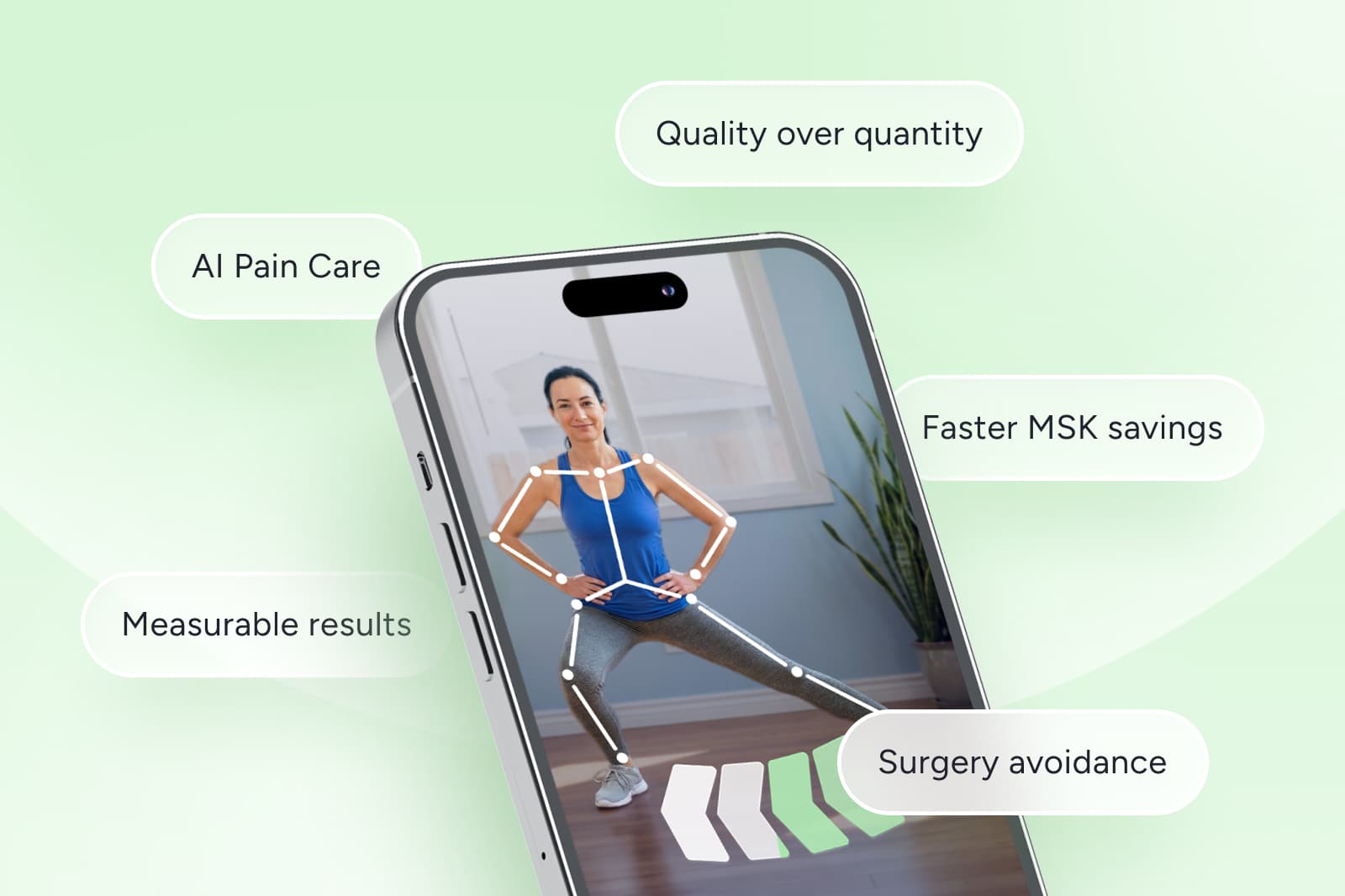
To translate these trends into practical evaluation, use a simple lens: predictability, proof, and practicality.
Predictability
- Does the model reduce volatility, or only promise average savings?
- Is the financial model easy to explain to finance and leadership?
- Are downside protections real, or symbolic?
Proof
- Are outcomes tied to meaningful improvement, not proxy activity?
- Is reporting continuous and transparent at the member level?
- Is there independent or claims-based validation where it matters?
Practicality
- What does implementation require from the plan or employer team?
- How does the program drive adoption and sustained engagement?
- What governance exists for model performance and ongoing measurement?
How value-based care should work
If value-based care is the future, the strongest versions share a common trait: they make incentives hard to ignore.
That is why outcome-based pricing in digital MSK matters as more than a pricing preference. It is an operating model that rewards the right behavior across the ecosystem:
- Payers and employers pay for measurable improvement, not utilization
- Members get a clearer path to recovery, with fewer low-value detours
- Vendors who consistently deliver high-quality outcomes are rewarded, while weaker solutions are pressured to improve or exit
Sword Health’s Outcome Pricing ties payments to measurable healthcare improvements. This aligns incentives around accountable, value-based care.¹² In plain terms, this is what the next wave is trying to achieve across healthcare: pay for recovery, measure it clearly, and share risk in a way that makes performance matter.
When paired with AI Care and careful clinical oversight, this approach also reinforces a simple truth: movement and timely MSK support helps people recover earlier, before cost and complexity harden into more expensive, acute care needs.
If you are evaluating where value-based care is headed next, start with a category where outcomes are measurable and contracts can be accountable. Review the Sword Predict ROI report and third-party validation, then explore Sword’s Outcome-based pricing model as a concrete example of how incentives can be aligned around measurable improvement.⁵⁶¹¹
About the author

Sword Editorial Team
Evidence-based healthcare insights


