June 2, 2025
How movement-based care supports outcomes during GLP-1 treatment
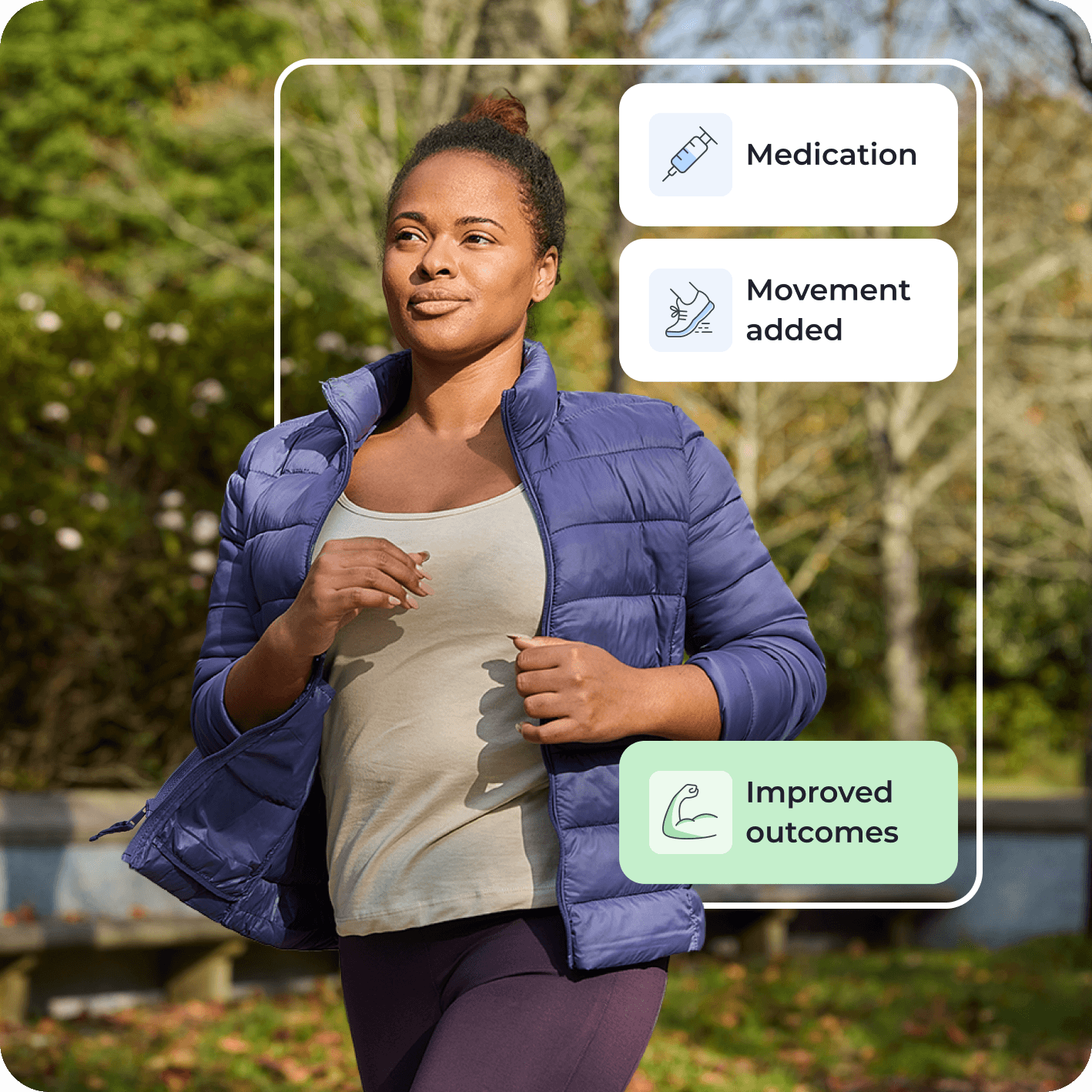 As GLP-1 adoption accelerates, organizations are grappling with how to support patient outcomes while avoiding new clinical risks and downstream costs.
GLP-1 medications are transforming obesity care. Without addressing inactivity and muscle loss, employers risk a new wave of MSK claims. Up to 70% of GLP-1 users discontinue use within a year1, and many regain weight after treatment ends. Movement is the missing link to lasting results, improved quality of life, and sustainable cost control.
GLP-1s can cost employers up to $10,000 per member annually2, yet many of these dollars are going to members without long-term habit change.
Leading employers are solving for this risk by adding structured movement plans to support GLP-1 use and protect lean muscle mass.
In this exclusive white paper, Sword Health explores how Sword complements GLP-1 strategies by reinforcing sustainable physical activity. If your organization is investing in GLP-1s, this is essential reading.
Muscle retention is an ROI-protector for GLP-1 care plans
- Up to 39% of lean body mass is lost during GLP-1 use5
- 1 in 4 Americans engage in regular physical activity6
- Inactivity contributes to 27% of total employee medical spend7
- Sarcopenia contributes nearly $900 in excess healthcare costs per employee each year8
- 78% of Sword users report feeling moderately better or much better9
- 69% of inactive and insufficiently active members members reach active or healthy active status within 10 weeks10
Contributors to White Paper

Sword Team
Experts in pain, movement, and digital health
Footnotes
- 1
Wilding JPH et al. “Sustainability of weight loss with GLP-1 receptor agonists: a retrospective real-world study.” PubMed. https://pubmed.ncbi.nlm.nih.gov/38717042/
- 2
WTW. “GLP-1 drugs: implications for employer health plans.” WTW Insights. February 2024. https://www.wtwco.com/en-us/insights/2024/02/glp-1-drugs-implications-for-employer-health-plans
- 3
Prado CM, Wells JC, Smith SR, Stephan BC, Siervo M. “Muscle matters: the effects of medically induced weight loss on skeletal muscle.” The Lancet Diabetes & Endocrinology. 2024;12(11):785–787.
- 4
Sword Health. “MET-min analysis, Move Members 2024: over 500 MET-minutes per week.” Internal dataset.
- 5
Prado CM, Wells JC, Smith SR, Stephan BC, Siervo M. “Muscle matters: the effects of medically induced weight loss on skeletal muscle.” The Lancet Diabetes & Endocrinology. 2024;12(11):785–787.
- 6
Elgaddal N, Kramarow EA, Reuben C. “Physical activity among adults aged 18 and over: United States, 2020.” NCHS Data Brief No. 443. National Center for Health Statistics, 2022. https://dx.doi.org/10.15620/cdc:120213
- 7
Duijvestijn M, de Wit GA, van Gils PF, Wendel-Vos GCW. “Impact of physical activity on healthcare costs: a systematic review.” BMC Health Services Research. 2023;23(1):572. doi:10.1186/s12913-023-09556-8
- 8
Janssen I, Shepard DS, Katzmarzyk PT, Roubenoff R. “The healthcare costs of sarcopenia in the United States.” Journal of the American Geriatrics Society. 2004 Jan;52(1):80–85. https://pubmed.ncbi.nlm.nih.gov/14687319/
- 9
Sword Health. Referencing “Members with 5+ activities and PGIC scores of 5 or higher.” Internal member base data, 2023–2024.
- 10
Sword Health. “MET-min analysis, Move Members 2024: over 500 MET-minutes per week.” Internal dataset.


