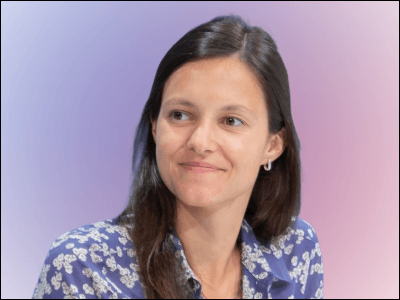
Catarina Botelho is an AI Researcher at Sword Health, where she works on large language models for mental health. Her research sits at the intersection of language models and clinical AI, focused not only on whether models perform well in benchmarks, but on how they behave in the real world, and what real care interactions can teach us about supporting people better.
At Sword, her work centers on the observability and safety of LLMs deployed in care, drawing rigorous insight from real care interactions so that what models learn translates into systems that are reliable and clinically meaningful.
Before joining Sword, Catarina was a researcher at INESC-ID in Lisbon, building AI solutions to support medical diagnosis through the analysis of speech signals, for conditions such as Alzheimer's and Parkinson's disease. Her work focused on interpretable models that enable meaningful dialogue with the medical community. Her doctoral thesis received the ULisboa RedeSaúde Award for best PhD work in health systems and digital transition, and earned first place at the University of Lisbon's Three Minute Thesis competition.
Education
Catarina holds a PhD in Electrical and Computer Engineering from Instituto Superior Técnico, University of Lisbon, completed in 2024 with the distinction "Pass with Distinction and Honour." Her thesis, Speech as a Biomarker for Multidisease Screening, was supervised by Isabel Trancoso, Alberto Abad, and Tanja Schultz. She holds an MSc in Biomedical Engineering from Instituto Superior Técnico, completed with a grade of 18/20, and was recognized with the Maria de Lourdes Pintasilgo Award for outstanding female graduates in STEM.
Experience
Before joining Sword Health, Catarina was a researcher at INESC-ID for nearly eight years, where she published research on speech-based disease detection and automatic speech recognition for European Portuguese at venues including IEEE Access, the IEEE Journal of Selected Topics in Signal Processing, ICASSP, and Interspeech. She has also held research positions at Google AI in Toronto and as a visiting researcher at the Cognitive Systems Lab at the University of Bremen. She also served as a Teaching Assistant for the graduate course "Speech Processing" at Instituto Superior Técnico.